
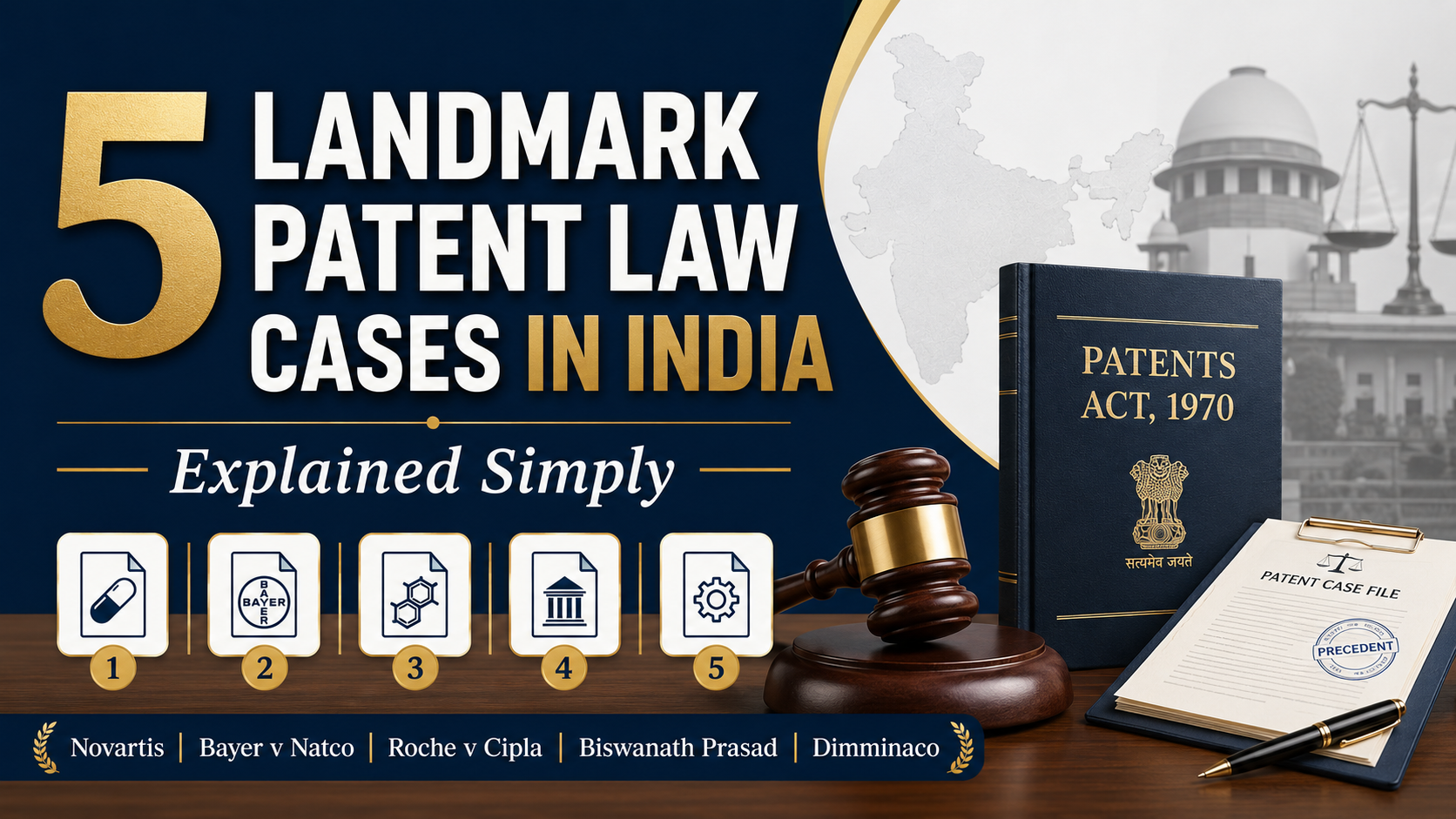
The Patents Act, 1970, lays down the main rules governing patents in India. However, courts and patent authorities play an equally important role in explaining how these rules apply to real inventions and disputes.
The following five cases have significantly influenced Indian patent law. They explain important principles relating to inventive step, biological inventions, pharmaceutical patents, compulsory licensing, claim interpretation, and patent infringement.
1. Biswanath Prasad Radhey Shyam v. Hindustan Metal Industries
Background of the Case
Biswanath Prasad Radhey Shyam v. Hindustan Metal Industries, reported in (1979) 2 SCC 511, is a leading Supreme Court decision on noveltyand the inventivee step.
Hindustan Metal Industries owned a patent relating to a method and device used in the manufacture of utensils. The company claimed that its patented method improved the process of making utensils and prevented defects during production.
The company alleged that Biswanath Prasad Radhey Shyam was using the same patented method without permission and therefore filed a patent infringement suit.
The defendant challenged the validity of the patent. It argued that the method described in the patent was already known in the utensil-manufacturing industry and did not involve any genuine invention.
Legal Issue before the Court
The main question before the Supreme Court was whether the patented method was genuinely new and involved sufficient inventive skill.
The Court had to decide whether the method was a patentable invention or merely an ordinary improvement that a skilled worker could easily make.
Decision of the Supreme Court
The Supreme Court explained that every change or improvement does not qualify as an invention.
To receive patent protection, an invention must involve something more than the ordinary skill and knowledge of a person working in that technical field. If a skilled person could make the same change during routine work, the change would be considered obvious.
The Court described such an obvious change as a mere workshop improvement.
After examining the available evidence, the Court found that the patented method did not involve sufficient novelty or inventive ingenuity. The alleged invention was based on methods already known and used in the industry.
The patent was therefore held to be invalid.
Importance of the Case
This case established an important test for inventive step in India.
A patent cannot be granted merely because a product or process has been slightly changed. The improvement must not be obvious to a person having ordinary skill in the relevant field.
The decision also clarified that the grant of a patent by the Patent Office does not make the patent permanently valid. Its validity may still be challenged during infringement or revocation proceedings.
2. Dimminaco AG v. Controller of Patents and Designs
Background of the Case
Dimminaco AG v. Controller of Patents and Designs is an important Calcutta High Court decision concerning biological inventions.
Dimminaco AG filed a patent application for a process used to prepare a vaccine for infectious bursitis, a disease affecting poultry.
The process involved the use of a live virus, and the final vaccine also contained living material.
The Patent Office rejected the application on the ground that the process did not result in a patentable manufacture. According to the Patent Office, a process whose final product contained a living organism could not qualify as an invention under the law as it then stood.
Dimminaco challenged the rejection before the Calcutta High Court.
Legal Issue before the Court
The main issue was whether a process could be patentable when the final product contained living material.
The Court also considered whether the vaccine produced through the process was a useful and commercially valuable product.
Decision of the Calcutta High Court
The Calcutta High Court rejected the view that a process becomes non-patentable merely because its final product contains a living organism.
The Court observed that the vaccine was a new and useful product that could be commercially manufactured and sold. It had practical value because it could be used to protect poultry against disease.
The fact that the vaccine contained living material did not remove it from the meaning of manufacture.
The Court therefore set aside the rejection and directed the Patent Office to reconsider the application according to law.
Importance of the Case
This decision became an important development in Indian biotechnology patent law.
It established that a biological or microbiological process should not be rejected only because living material is involved. The correct question is whether the claimed process produces a new, useful, and commercially valuable result.
The case helped create a more practical approach towards patent applications involving vaccines, microorganisms, and biotechnology.
However, such inventions must still satisfy all other requirements of the Patents Act, including novelty, inventive step, industrial application, and the exclusions listed under Section 3.
3. Novartis AG v. Union of India
Background of the Case
Novartis AG v. Union of India, reported in 6 SCC 1 (2013), is one of the most important pharmaceutical patent cases in India.
The dispute concerned a cancer medicine sold under the name Glivec. Novartis applied for a patent covering the beta-crystalline form of imatinib mesylate.
Imatinib and its connection with imatinib mesylate had already been disclosed in earlier research and patent documents. Novartis claimed that the beta-crystalline form was different because it had improved physical properties.
The company stated that the new form had better stability, lower moisture absorption, improved processing qualities, and greater bioavailability.
Generic medicine companies and public-health organisations opposed the application. They argued that it was only a new form of an already known substance and did not satisfy Section 3(d) of the Patents Act.
Legal Issue before the Court
The main question was whether the beta-crystalline form of imatinib mesylate was patentable under Indian law.
The Supreme Court had to decide whether the claimed improvements amounted to an enhancement of efficacy under Section 3(d).
Meaning of Section 3(d)
Section 3(d) deals with new forms of known substances.
A new form of a known substance cannot receive a patent unless it shows a significant improvement in the known efficacy of that substance.
In pharmaceutical cases, the Supreme Court explained that the relevant test is therapeutic efficacy.
Therapeutic efficacy means the medicine’s ability to produce a better healing or treatment effect. Physical or manufacturing benefits do not automatically prove that the medicine treats a disease more effectively.
Decision of the Supreme Court
The Supreme Court found that Novartis had shown that the beta-crystalline form had certain improved physical properties. However, the company had not produced sufficient evidence showing that these properties improved the therapeutic effect of the medicine.
The Court also considered the claim of increased bioavailability.
It did not state that increased bioavailability could never be relevant. Instead, it held that increased bioavailability alone does not automatically establish enhanced therapeutic efficacy.
The applicant must prove that the increased bioavailability leads to a meaningful improvement in the treatment of patients.
Novartis failed to provide sufficient evidence of such therapeutic improvement. The Supreme Court therefore rejected the patent claim under Section 3(d).
Importance of the Case
The Novartis judgement clarified the meaning and purpose of Section 3(d).
It established that a pharmaceutical company cannot obtain a new patent merely by changing the form of a known medicine. The company must show that the new form provides a genuine improvement in therapeutic efficacy.
The decision strengthened protection against patent evergreening, which occurs when repeated patents are sought for minor changes to an existing medicine in order to extend market exclusivity.
The Court did not prohibit patents for all improvements to existing medicines. A genuine improvement may still be patented if it satisfies novelty, inventive step, industrial application, and the enhanced-efficacy requirement where Section 3(d) applies.
4. Bayer Corporation v. Natco Pharma Ltd.
Background of the Case
The Bayer–Natco dispute is the most important Indian case concerning compulsory licensing.
Bayer Corporation owned an Indian patent for sorafenib tosylate, a medicine sold under the brand name Nexavar. The medicine was used in the treatment of advanced kidney and liver cancer.
Bayer’s medicine was sold at approximately ₹2.8 lakh for one month of treatment.
Natco Pharma approached Bayer for a voluntary licence but was unable to obtain one. Natco then applied for a compulsory licence under Section 84 of the Patents Act.
Natco proposed to manufacture and sell its version of the medicine for approximately ₹8,800 per month.
Legal Issue before the Controller
The Controller had to decide whether the conditions for granting a compulsory licence under Section 84 had been satisfied.
Natco argued that the reasonable requirements of the public were not being met, the medicine was not available at a reasonably affordable price, and the invention was not adequately worked in India.
Decision of the Controller
The Controller found that only a small number of patients who required the medicine had been able to obtain it.
The quantity supplied by Bayer was insufficient when compared with the number of patients who needed treatment. The price charged by Bayer was also beyond the reach of most Indian patients.
In March 2012, the Controller granted a compulsory licence to Natco. It was the first compulsory licence granted in India under the modern product-patent system.
Natco was allowed to manufacture and sell the medicine subject to legal and commercial conditions. The licence was non-exclusive and non-transferrable. Natco was required to sell the medicine at the approved lower price and pay a royalty to Bayer.
The Controller initially fixed the royalty at six per cent of Natco’s net sales. The Intellectual Property Appellate Board later upheld the compulsory licence and increased the royalty to seven per cent.
Importance of the Case
The Bayer–Natco case showed that patent rights must be exercised in a way that also considers public access.
The mere presence of a patented product in the market is not always enough. The product must be available in sufficient quantity and at a price that can reasonably be afforded by the people who require it.
The case also clarified that compulsory licensing does not cancel the patent. The patentee continues to own the patent and receives royalty payments, while another qualified person is permitted to use the invention under controlled conditions.
The decision remains a leading example of how Indian patent law balances the interests of patent owners with public health and access to medicines.
5. F. Hoffmann-La Roche Ltd. v. Cipla Ltd.
Background of the Case
F. Hoffmann-La Roche Ltd. v. Cipla Ltd. is an important Delhi High Court decision on pharmaceutical patent infringement and interpretation of patent claims.
Roche owned an Indian patent covering erlotinib hydrochloride, a compound used in the treatment of cancer. Roche marketed the medicine under the brand name Tarceva.
Cipla introduced a lower-priced medicine called 'Erlocip', which also contained erlotinib hydrochloride.
Roche filed a patent infringement suit against Cipla. It argued that Cipla’s medicine fell within the scope of its patent.
Cipla denied infringement and challenged the validity of Roche’s patent.
Legal Issue before the Court
The Delhi High Court had to determine whether Cipla’s product fell within the legal scope of Roche’s patent claims.
Cipla argued that its medicine contained a particular crystalline form known as Polymorph B and that Roche’s Indian patent did not specifically claim that form.
The Court therefore had to interpret the patent claims and compare them with Cipla’s product.
Decision of the Delhi High Court
The Delhi High Court explained that patent infringement must be decided by examining the language of the claims.
The court must first understand what the claims legally protect. It must then compare the essential features of those claims with the allegedly infringing product or process.
The question is not limited to whether the two commercial products look or operate in exactly the same way. The real question is whether the defendant’s product contains the essential elements covered by the patent claims.
The Division Bench held that Roche’s claim covered erlotinib hydrochloride as a compound and was not limited to only one crystalline form.
Cipla’s Polymorph B was still a form of erlotinib hydrochloride and therefore fell within the scope of Roche’s patent.
The Court consequently found that Cipla had infringed Roche’s patent.
Importance of the Case
This case provides important guidance on the interpretation of patent claims.
A patent owner cannot establish infringement merely by comparing brand names, packaging, or finished products. The court must interpret the claims and identify their essential technical features.
The case also explains that a person may not avoid infringement simply by making a different form of the patented compound if that form remains covered by the properly interpreted claims.
The judgement is also important for its discussion of inventive step. The Court explained that the assessment should consider the knowledge of a person skilled in the relevant field, the inventive concept, the prior art, and whether the claimed difference would have been obvious on the priority date.
Conclusion
These cases show how Indian patent law balances the rights of inventors with public interest. The courts have made it clear that patents are granted only for genuine inventions that are new, useful, and non-obvious. They have also protected access to medicines through Section 3(d) and compulsory licensing, while they have enforced valid patent rights against infringement. Together, these decisions have helped create a patent system that rewards innovation without allowing unfair monopolies.


