
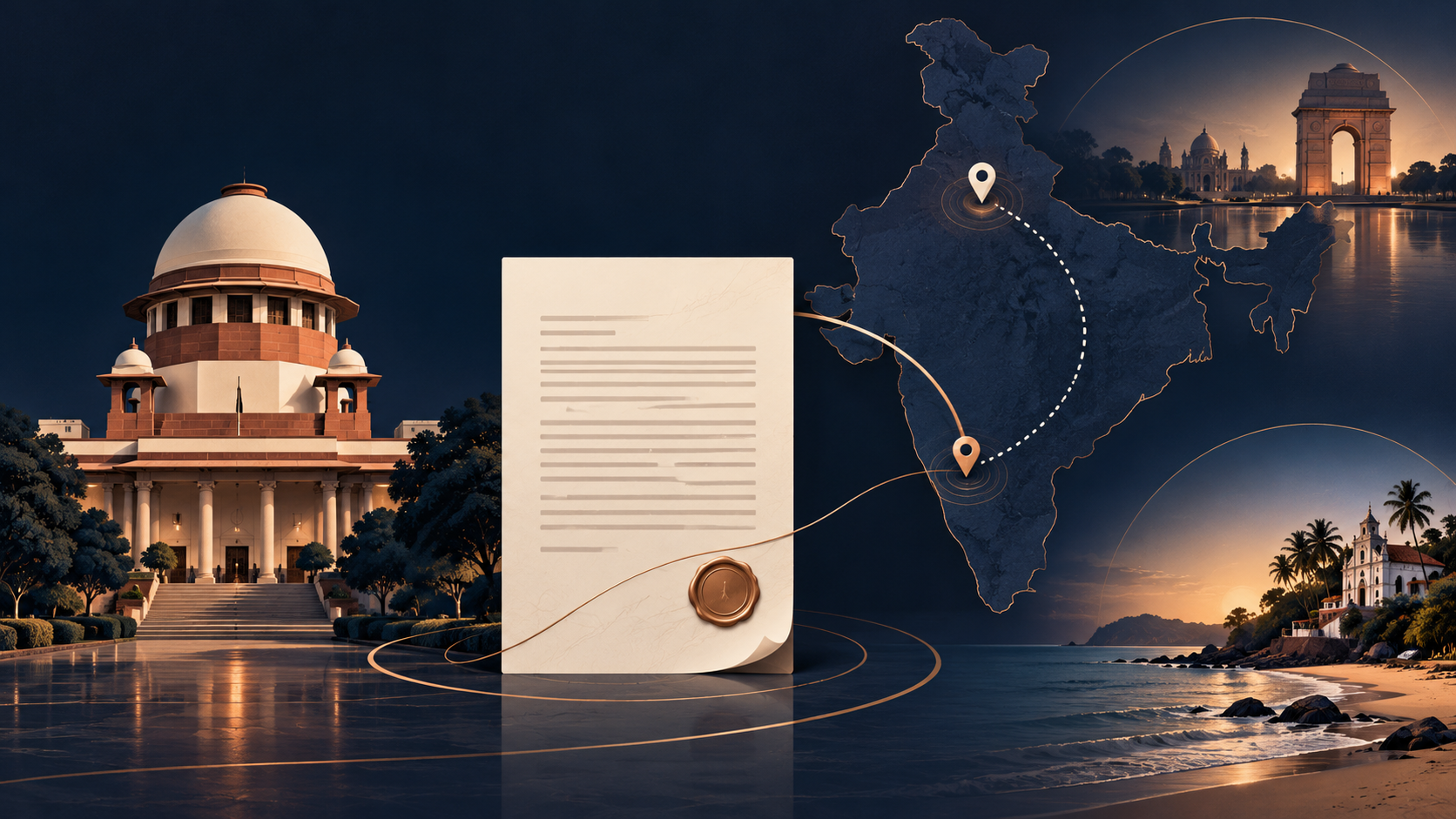
Quick answer: On 12 October 2026, the Supreme Court held that Goa was the juridical seat of an arbitration under a franchise agreement that mentioned both Delhi and Goa. The contract placed arbitration “within Delhi”, also said proceedings would be held in Goa, and gave Goa courts exclusive jurisdiction. Reading those clauses together, the Court found that the Delhi High Court could not appoint an arbitrator under Section 11(6) of the Arbitration and Conciliation Act, 1996.
In Arcis Clean Energy Pvt. Ltd. v. Parshva Innovation, a Bench of Justices Manoj Misra and Vijay Bishnoi set aside the Delhi High Court’s appointment order. The ruling is useful for anyone drafting an arbitration clause or choosing the court for an appointment application: a named location does not decide the seat in isolation when the same agreement points to another location and another set of courts.
What did the franchise agreement say?
The parties’ franchise agreement was dated 3 August 2023. When a dispute arose, Parshva Innovation proposed a sole arbitrator. Arcis Clean Energy rejected the proposal, and Parshva moved the Delhi High Court under Section 11(6) for an appointment. The High Court appointed an arbitrator by an order dated 11 November 2025 and left the hearing venue to be selected in consultation with the parties.
The problem was the contract’s competing location language:
| Contract term | What it indicated |
|---|---|
| Clause 32.4 | The precise location of arbitration was to be within Delhi. |
| Clause 32.5 | The arbitration proceedings were to be held in Goa. |
| Clause 38 | The parties submitted to the exclusive jurisdiction of competent courts in Goa. |
Arcis argued that Goa was the legal seat and the Delhi High Court therefore lacked jurisdiction. Parshva relied on the Delhi wording in the arbitration clause and argued that the separate governing-law and jurisdiction clause could not determine the seat. The sequence of the two sub-clauses was also raised: Parshva said the earlier Delhi reference should prevail over the later Goa reference.
Why does the seat matter for a Section 11 application?
The juridical seat is the legal home of an arbitration. It identifies the courts that exercise supervisory jurisdiction over the proceedings. A venue is a location for hearings or other practical steps; it does not necessarily carry the same jurisdictional consequences. The parties may choose a neutral seat even where no part of the underlying commercial cause of action arose there.
This distinction mattered immediately. The question before the Supreme Court was whether the Delhi High Court was the appropriate court to exercise the appointment power under Section 11(6), rather than merely where an arbitrator could convene hearings. If Goa was the seat, a Delhi appointment could not stand on the wording of this agreement.
The Court discussed earlier decisions including Indus Mobile Distribution v. Datawind Innovations, BGS SGS SOMA JV v. NHPC, and Arif Azim Company v. Micromax Informatics FZE. Its analysis did not treat every mention of a place as an automatic choice of seat. In particular, the familiar inference from a single fixed venue had to be examined with care because this arbitration clause named two places.
How did the Supreme Court read Delhi, Goa and the exclusive-jurisdiction clause?
The Court read the agreement as a whole. Clause 32.4 referred to Delhi as the location, but the very next sub-clause placed proceedings in Goa. Clause 38 then chose the competent courts in Goa exclusively. Giving the provisions a workable meaning together, the Court identified Goa as the juridical seat and Delhi as a venue.
Parshva’s argument that an arbitration clause is independent of the main contract did not answer the issue. The Court accepted the general principle of separability, but observed that the arbitration clause itself contained both the Delhi and Goa references. It could not resolve that internal tension by ignoring the agreement’s jurisdiction clause. Nor did the mere fact that the Delhi sentence came first settle the parties’ intention.
The point is fact-sensitive. An exclusive court clause is a significant indicator in this contract because it named one of the two places already appearing in the arbitration provisions. The ruling should not be reduced to a rule that a governing-law clause always overrides an unambiguous arbitration seat clause. The Court’s task was to make sense of this agreement’s three relevant terms without discarding any of them.
What was the outcome?
The Supreme Court allowed Arcis Clean Energy’s appeal and set aside the Delhi High Court’s order appointing the arbitrator. It held that the Delhi High Court lacked jurisdiction to entertain the Section 11(6) application because the juridical seat was Goa. The parties were left free to take appropriate proceedings before the jurisdictional High Court. The Court did not decide the merits of their commercial dispute.
For a practitioner checking a proposed Section 11 filing, this judgment suggests a practical order of reading: examine every reference to where arbitration will take place; distinguish the legal seat from a hearing location; then read the court-jurisdiction clause together with the arbitration clause. If the document names different cities, the answer may depend on the entire drafting rather than one convenient sentence.
For contract drafting, it is safer to state the seat expressly and separately identify any flexible hearing venues. That is a drafting implication of the dispute the Court resolved, not an additional holding about the parties’ obligations. Readers interested in another appointment-related issue can also see our Supreme Court update on personal guarantee arbitration.
Case: Arcis Clean Energy Pvt. Ltd. v. Parshva Innovation, Civil Appeal No. 13663 of 2026, Supreme Court of India, 12 October 2026. Read the official Supreme Court judgment.


