
India’s labour law framework has historically been complex, fragmented, and difficult to navigate. Employers were required to comply with multiple overlapping laws, while workers especially those outside the formal sector often remained excluded from basic protections. To address these systemic issues, the Government of India introduced one of the most significant labour law reforms in independent India.
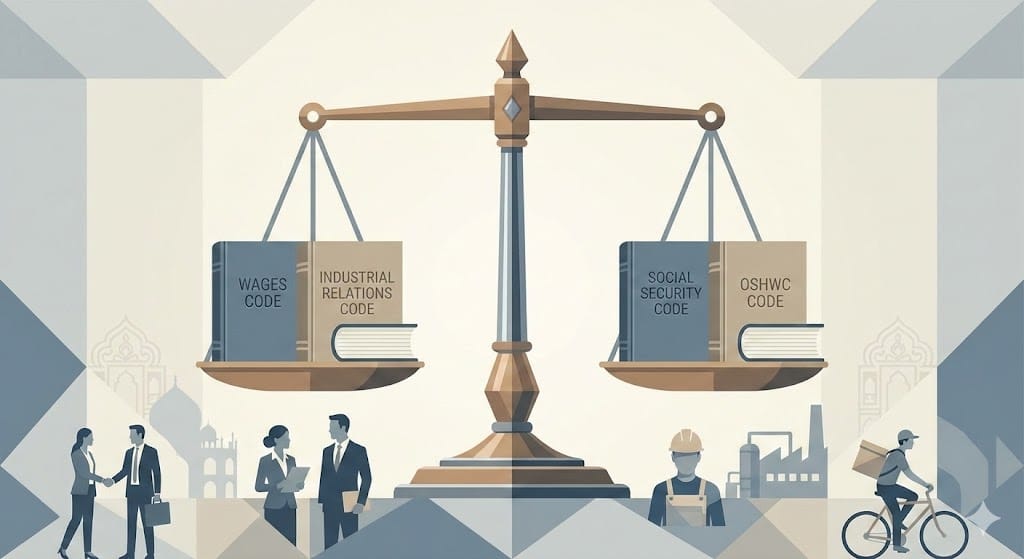
On 21 November 2025, the Central Government consolidated 29 existing central labour laws into four comprehensive Labour Codes. These codes are designed to simplify compliance, improve enforcement, and extend statutory protection to a much wider section of the workforce, including gig workers, platform workers, and contract labour.
The reform is not merely administrative. It fundamentally alters how wages are structured, how employment is formalized, how social security is calculated, and how industrial relations are governed. For anyone operating in the legal, HR, compliance, or policy space, a clear understanding of these Codes is essential.
The Objective Behind the Labour Law Consolidation
The earlier labour law regime suffered from three major weaknesses. First, there was excessive fragmentation; different laws governed wages, safety, social security, and disputes, often using inconsistent definitions. Second, enforcement was uneven, with overlapping inspections and outdated compliance mechanisms. Third, a large section of India’s workforce, particularly in the unorganized and gig economy, remained outside the legal safety net.
The four Labour Codes aim to resolve these issues by introducing uniform definitions, digital compliance systems, and expanded coverage, while also reducing unnecessary regulatory burdens on employers. The emphasis is on formalization, transparency, and predictability in employment relationships .
Overview of the Four Labour Codes
The new labour framework consists of the following four codes:
| Labour Code | Core Area Governed |
|---|---|
| Code on Wages, 2019 | Minimum wages, wage payment, bonus, equal remuneration |
| Industrial Relations Code, 2020 | Trade unions, standing orders, strikes, layoffs and retrenchment |
| Code on Social Security, 2020 | PF, ESIC, gratuity, maternity benefits, gig and platform workers |
| Occupational Safety, Health and Working Conditions Code, 2020 | Workplace safety, health, working hours, licences |
Each Code replaces multiple older statutes and standardizes key legal concepts such as “wages,” “worker,” “establishment,” and “employer.”
Structural Shift: Labour Law Before and After the Codes
One of the most practical ways to understand the reform is to compare the earlier regime with the new framework.
| Area | Earlier Position | Position Under Labour Codes |
|---|---|---|
| Employment Documentation | Appointment letters not mandatory | Appointment letters compulsory for all workers |
| Minimum Wages | Limited to scheduled employments | Statutory right for every worker |
| Social Security | Mostly limited to organised sector | Extended to gig, platform, and unorganised workers |
| Compliance | Multiple registrations and returns | Single registration, licence, and return |
| Women’s Employment | Restricted in night shifts | Permitted with consent and safety |
| ESIC Coverage | Area and sector based | Pan-India coverage |
This shift clearly reflects the state’s intention to formalize employment and universalise labour protection.
Code on Wages, 2019: Redefining Wages and Pay Structures
The Code on Wages is the foundation of the new labour law architecture because it directly affects salary structures across sectors.
Under the earlier regime, minimum wages applied only to scheduled employments, leaving many workers uncovered. The new Code guarantees minimum wages for all workers, irrespective of sector or nature of employment. The appropriate government is now legally bound to fix minimum wages for time work and piece work.
A critical change introduced by this Code is the uniform definition of “wages.” Wages now include basic pay, dearness allowance, and retaining allowance. While certain components such as HRA, bonuses, and statutory contributions may be excluded, the law mandates that excluded components cannot exceed 50% of total remuneration. Any excess must be added back to wages.
This provision has far-reaching implications. It directly impacts provident fund contributions, gratuity calculations, overtime pay, and bonus eligibility. Many employers who earlier structured salaries with low basic pay will now be required to restructure compensation.
The Code also strengthens gender equality by expressly prohibiting wage discrimination on the basis of gender and mandates overtime payment at twice the normal wage rate for work beyond prescribed hours.
Industrial Relations Code, 2020: Employment Stability and Dispute Management
The Industrial Relations Code modernises the legal framework governing employer–employee relationships.
One of the most significant changes is the replacement of the term “workman” with “worker”. The definition now includes not only manual and clerical staff but also working journalists, sales promotion employees, and supervisors earning up to a notified wage threshold. This brings a wider class of employees within statutory protection.
The Code gives formal legal recognition to Fixed-Term Employment (FTE). Fixed-term employees are now entitled to the same wages, hours of work, and benefits as permanent employees performing similar work. Importantly, fixed-term employees become eligible for gratuity after just one year of continuous service, a major departure from the earlier five-year requirement.
On industrial action, the Code expands the definition of “strike” to include mass casual leave by 50% or more workers. Notice requirements for strikes and lockouts have been standardised, ensuring predictability in industrial relations.
For large establishments employing 300 or more workers, prior government permission is required for layoffs, retrenchment, and closure, reinforcing employment security while still allowing flexibility for smaller units.
Code on Social Security, 2020: Extending Protection Beyond Formal Employment
The Code on Social Security is perhaps the most socially transformative of the four Codes. For the first time in Indian labour law, gig workers and platform workers are formally recognized.
Aggregators operating digital platforms are required to contribute a percentage of their annual turnover towards a social security fund for gig and platform workers. These benefits are Aadhaar-linked and portable across states, addressing the long-standing issue of migrant labour exclusion.
The Code expands ESIC coverage to a pan-India level, removing the earlier concept of “notified areas.” Establishments with fewer than ten employees may opt in voluntarily, while hazardous occupations are mandatorily covered irrespective of size.
Another important reform is the expansion of the definition of “dependent.” The Code now includes maternal grandparents and, in the case of female employees, dependent parents-in-law, significantly widening access to family benefits.
The law also introduces time-bound EPF inquiries, reducing prolonged litigation and compliance uncertainty.
Occupational Safety, Health and Working Conditions Code, 2020
This code consolidates thirteen safety-related laws into a single framework and applies across factories, mines, plantations, construction sites, and service establishments.
A major reform is the introduction of single electronic registration and common licensing. Establishments with ten or more workers must register electronically, and a single license can cover factories, contract labour, and industrial premises. Licenses are deemed approved if authorities fail to act within prescribed timelines.
The Code strengthens occupational health safeguards by mandating free annual health check-ups, regulating working hours to a maximum of eight hours per day and forty-eight hours per week, and requiring consent-based overtime with double wages.
Women are now legally permitted to work night shifts and in all sectors, including hazardous industries, subject to consent and prescribed safety measures.
The Code also introduces mandatory safety committees in establishments employing 500 or more workers and establishes a National Occupational Safety and Health Board to standardize safety norms across sectors.
Sector-Wise Impact of the Labour Codes
The new labour framework has sector-specific implications. Fixed-term employees gain equal benefits and faster gratuity eligibility. Gig and platform workers receive statutory recognition and social security coverage. MSME workers benefit from simplified compliance, guaranteed minimum wages, and social security access. Women workers gain equal pay, expanded employment opportunities, and enhanced safety protections.
Workers in hazardous industries, mines, plantations, media, IT, export sectors, and dock work are now governed under uniform safety, wage, and welfare standards, replacing fragmented and outdated rules.
Compliance and Enforcement Philosophy Under the New Codes
A notable shift across all four codes is the move from punitive enforcement to compliance facilitation. The traditional inspector system has been replaced with an inspector-cum-facilitator model, focusing on guidance, digital inspections, and awareness.
Most first-time offenses now attract monetary penalties instead of imprisonment, with opportunities for compounding and prior compliance notices. This reflects a balance between worker protection and ease of doing business.
Frequently Asked Questions
1. When did the New Labour Codes come into force?
The four Labour Codes were enacted between 2019 and 2020, and the Central Government announced their consolidated implementation framework on 21 November 2025. However, actual enforcement depends on state-wise notification of rules, since labour is a concurrent subject. Some states have already notified rules, while others are in the process of doing so.
2. Do the New Labour Codes reduce employee take-home salary?
No. The Labour Codes do not automatically reduce take-home pay. Provident Fund deductions continue to be calculated on the statutory wage ceiling of ₹15,000 unless the employer and employee voluntarily opt for higher contributions. However, salary restructuring may be required to comply with the 50% wage definition, which can affect PF and gratuity calculations, not net salary by default.
3. Are appointment letters mandatory under the new labour laws?
Yes. Mandatory appointment letters are a key reform under the new Labour Codes. Employers must issue written appointment letters to all workers, ensuring transparency regarding wages, job role, and social security benefits. This applies across sectors, including fixed-term, contract, and informal employment.
4. How do the Labour Codes affect gig and platform workers?
For the first time, gig workers and platform workers are legally recognised under the Code on Social Security, 2020. Aggregators are required to contribute a percentage of their turnover to a social security fund. Benefits are Aadhaar-linked and portable across states, providing basic welfare coverage even without a traditional employer–employee relationship.
5. What is the 50% wage rule and why is it important?
The 50% rule states that allowances and exclusions from “wages” cannot exceed 50% of total remuneration. If they do, the excess is added back to wages. This rule ensures that employers do not artificially reduce basic wages to lower statutory contributions such as PF and gratuity. It brings uniformity and fairness in wage calculations.
6. Are women allowed to work night shifts under the new Labour Codes?
Yes. The Occupational Safety, Health and Working Conditions Code, 2020 permits women to work night shifts and in all sectors, including hazardous industries, subject to their consent and prescribed safety measures. This reform removes earlier blanket restrictions and promotes equal employment opportunities.
7. How have compliance and inspections changed under the new framework?
The traditional inspector system has been replaced with an Inspector-cum-Facilitator model. The focus has shifted from punishment to guidance and compliance support. Inspections are increasingly digital, web-based, and risk-assessed, reducing harassment while improving transparency.
8. Do the Labour Codes apply to small businesses and MSMEs?
Yes. The Labour Codes apply to MSMEs, though with higher thresholds and simplified compliance. MSME workers are now covered under social security provisions, minimum wages are guaranteed, and compliance has been streamlined through single registration, licence, and return systems. This balances worker protection with ease of doing business.