
PATENT IN ADDITION
Introduction
Invention is not a one-time event; it is often a process of gradual improvement. An inventor may first obtain a patent for a new product or process, but later, after working with the invention, he may discover ways to improve or modify it. Filing a fresh patent application every time such an improvement is made would not only be inconvenient but also costly and legally confusing. To solve this problem, the Patents Act, 1970 provides a mechanism called a Patent of Addition.
A Patent of Addition is meant to protect improvements or modifications in an already patented invention. It is closely tied to the main patent and does not exist independently. This system encourages inventors to continue refining their inventions while ensuring that their rights are protected under the law.
Statutory Provisions
The provisions regarding Patent of Addition are contained in Sections 54, 55, and 56 of the Patents Act, 1970.
- Section 54 deals with the grant of patents of addition.
- Section 55 prescribes the term of a patent of addition.
- Section 56 discusses its validity.
Together, these sections establish the legal framework for protecting incremental improvements in inventions.
Meaning and Nature (Section 54)
According to Section 54(1), if an inventor has obtained a patent for an invention (the main patent) and later makes an improvement or modification in that invention, he may apply for a patent of addition relating to that improvement.
A key condition is that the applicant for the patent of addition must be the same person who owns the main patent. The Controller cannot grant a patent of addition before granting the main patent. This makes sense, because the patent of addition is dependent on the existence of the main patent.
For example, suppose an inventor patents a new washing machine in 2020. In 2022, he discovers a new water-saving system that can be fitted into the same machine. Instead of applying for a new patent, he can apply for a patent of addition to cover the improvement. This way, his original invention and its modification are both protected.
Term of a Patent of Addition (Section 55)
The duration of a patent of addition is tied to the duration of the main patent. Under Section 55(1), a patent of addition expires along with the main patent, regardless of when it was granted. This means it does not get its own 20-year term.
Another important advantage under Section 55(2) is that no separate renewal fee is required for maintaining a patent of addition. The fee paid for the main patent is sufficient to keep both the main patent and the patent of addition alive. This reduces the financial burden on inventors and makes the system attractive for those who regularly update their inventions.
Validity of Patent of Addition (Section 56)
Section 56 makes it clear that a patent of addition cannot be challenged on the ground that the improvement does not involve a sufficient inventive step. In other words, even if the modification is minor or obvious, as long as it is connected with the main invention, the patent of addition remains valid.
However, if the main patent is revoked, the patent of addition may survive only if the Controller permits it to be converted into an independent patent. This ensures that improvements are not lost merely because the original patent was revoked.
Importance and Advantages
The concept of a patent of addition provides several benefits. It encourages inventors to keep refining their inventions, knowing that even small modifications can be legally protected. It also reduces the cost of maintaining multiple patents since no separate renewal fee is needed. Furthermore, it provides legal certainty by ensuring that both the main invention and its improvements are protected under the same legal umbrella.
In industries like pharmaceuticals, electronics, and engineering, where minor but significant improvements are common, patents of addition play an important role in encouraging ongoing innovation.
Judicial Recognition
Indian courts have recognized the importance of patents of addition in various cases:
- In F. Hoffmann-La Roche Ltd. v. Cipla Ltd. (2009), the Delhi High Court observed that patents of addition are particularly useful in pharmaceutical research, where small but significant improvements to a drug or its process can be crucial.
- In Enercon (India) Ltd. v. Aloys Wobben (2013), the court highlighted that patents of addition ensure that technical improvements made by the same inventor are not exploited by competitors.
These cases underline that the law encourages inventors to continually improve their creations without being penalized by having to start an entirely new patent process.
Conclusion
A Patent of Addition is a unique feature of Indian patent law designed to protect incremental innovations. It recognizes that invention is an evolving process and allows inventors to patent improvements in their own inventions without the burden of separate renewals or the risk of losing priority. Governed by Sections 54 to 56 of the Patents Act, 1970, patents of addition ensure a balance between rewarding inventors and maintaining a practical, cost-effective patent system.
NON-PATENTABLE INVENTIONS
Introduction
The patent system is designed to reward creativity and encourage technological advancement. However, not every idea or discovery deserves a patent. Some inventions are excluded because they are against public policy, morality, natural laws, or lack inventive value. The Patents Act, 1970, under Sections 3 and 4, clearly lists the categories of inventions which are not patentable in India.
This ensures that patent rights are not misused to monopolize things that are not true inventions or that could harm society.
Section 3 – What are Not Inventions
According to Section 3 of the Patents Act, 1970, the following are not inventions within the meaning of the Act:
1. Frivolous Inventions [Section 3(a)]
Any invention which is trivial, frivolous, or contrary to natural laws is not patentable.
- Example: A machine claiming to produce perpetual motion (violating law of energy conservation).
2. Inventions Contrary to Public Order or Morality [Section 3(b)]
If an invention is immoral, harmful to human/animal/plant life, environment, or public health, it is excluded.
- Example: A device for committing theft or a chemical weapon.
- Case Law: Oncomouse Case (Harvard College v. Canada, 2002) – patent for genetically modified mouse rejected in Canada as contrary to morality.
3. Discovery of Scientific Principle or Abstract Theory [Section 3(c)]
The mere discovery of a natural principle or scientific phenomenon is not patentable unless it results in a practical application.
- Example: E = mc² or law of gravity cannot be patented.
4. Discovery of New Form of a Known Substance [Section 3(d)]
This is one of the most important clauses. It prevents evergreening of patents.
- Mere discovery of a new form of a known substance is not patentable unless it shows enhanced efficacy.
- Explanation to Sec. 3(d): Different forms like salts, esters, ethers, polymorphs, etc. are not patentable unless they show significantly improved efficacy.
- Case Law: Novartis AG v. Union of India (2013) – Supreme Court rejected patent for “Glivec” (cancer drug) because it was only a modified form of an existing compound without enhanced efficacy.
5. Mere Discovery of New Property or New Use of a Known Substance [Section 3(d) & 3(e)]
- If a known material is found to have a new use, it cannot be patented.
- Similarly, mere admixture of known substances without synergistic effect is not patentable.
- Example: Mixing sugar and water does not qualify as an invention.
6. Mere Arrangement or Re-arrangement [Section 3(f)]
The simple arrangement of known devices is not patentable unless it produces a new result.
- Example: Attaching two known cameras side by side.
7. Method of Agriculture or Horticulture [Section 3(h)]
Agricultural methods such as a method of increasing yield or irrigation technique cannot be patented.
- Rationale: Agriculture is vital for food security and should not be monopolized.
8. Any Process for Treatment of Humans or Animals [Section 3(i)]
Methods of medical treatment, surgery, or therapy are not patentable.
- Example: A surgical technique for heart surgery.
- But medical devices (like pacemakers) are patentable.
9. Plants, Animals, and Biological Processes [Section 3(j)]
- Plants and animals in whole or any part (except microorganisms) are not patentable.
- Essentially biological processes like breeding are excluded.
- Example: Genetically modified seeds.
10. Mathematical or Business Method, Computer Program per se [Section 3(k)]
- Algorithms, business methods, and software “per se” are not patentable.
- But if software has a technical application or hardware integration, it may qualify.
- Example: A mathematical formula is not patentable.
11. Aesthetic Creations [Section 3(l)]
Artistic, literary, musical, or dramatic works are not patents (they are protected under Copyright Act, 1957).
12. Scheme, Rule or Method of Performing Mental Act, Game or Business [Section 3(m)]
- Example: A new rule for playing chess.
13. Presentation of Information [Section 3(n)]
The mere display of information, like traffic signals, is not patentable.
14. Topography of Integrated Circuits [Section 3(o)]
These are protected under the Semiconductor Integrated Circuits Layout Design Act, 2000, not under patents.
15. Traditional Knowledge [Section 3(p)]
- Any invention based on traditional knowledge is not patentable.
- Example: Using neem extract for pesticide (already known in Ayurveda).
- Case: Neem Patent Case – European Patent Office revoked a patent on neem for fungicide as it was traditional Indian knowledge.
Section 4 – Inventions Relating to Atomic Energy
According to Section 4, no patent shall be granted in respect of inventions related to atomic energy.
- This is because atomic energy is a matter of national importance and public safety.
- It is governed separately by the Atomic Energy Act, 1962.
Importance of Sections 3 and 4
- They prevent misuse of patent law.
- Protect public health, safety, and environment.
- Encourage genuine innovation, not monopolies on trivial changes.
- Ensure balance between private rights and public interest.
Conclusion
The categories listed under Sections 3 and 4 of the Patents Act ensure that only true inventions with industrial application are granted patents. By excluding immoral, trivial, and harmful inventions, Indian patent law maintains a balance between rewarding inventors and safeguarding society.
TYPES OF PATENTS
Introduction
A patent is not a single uniform category; it varies depending on what exactly is being protected and how the invention is applied. The Patents Act, 1970 (as amended in 2005) recognizes different types of patents to suit different situations. This classification is not expressly listed in one section of the Act but emerges from a reading of provisions like Sections 2(1)(j), 5, 54–56, 135, and related rules.
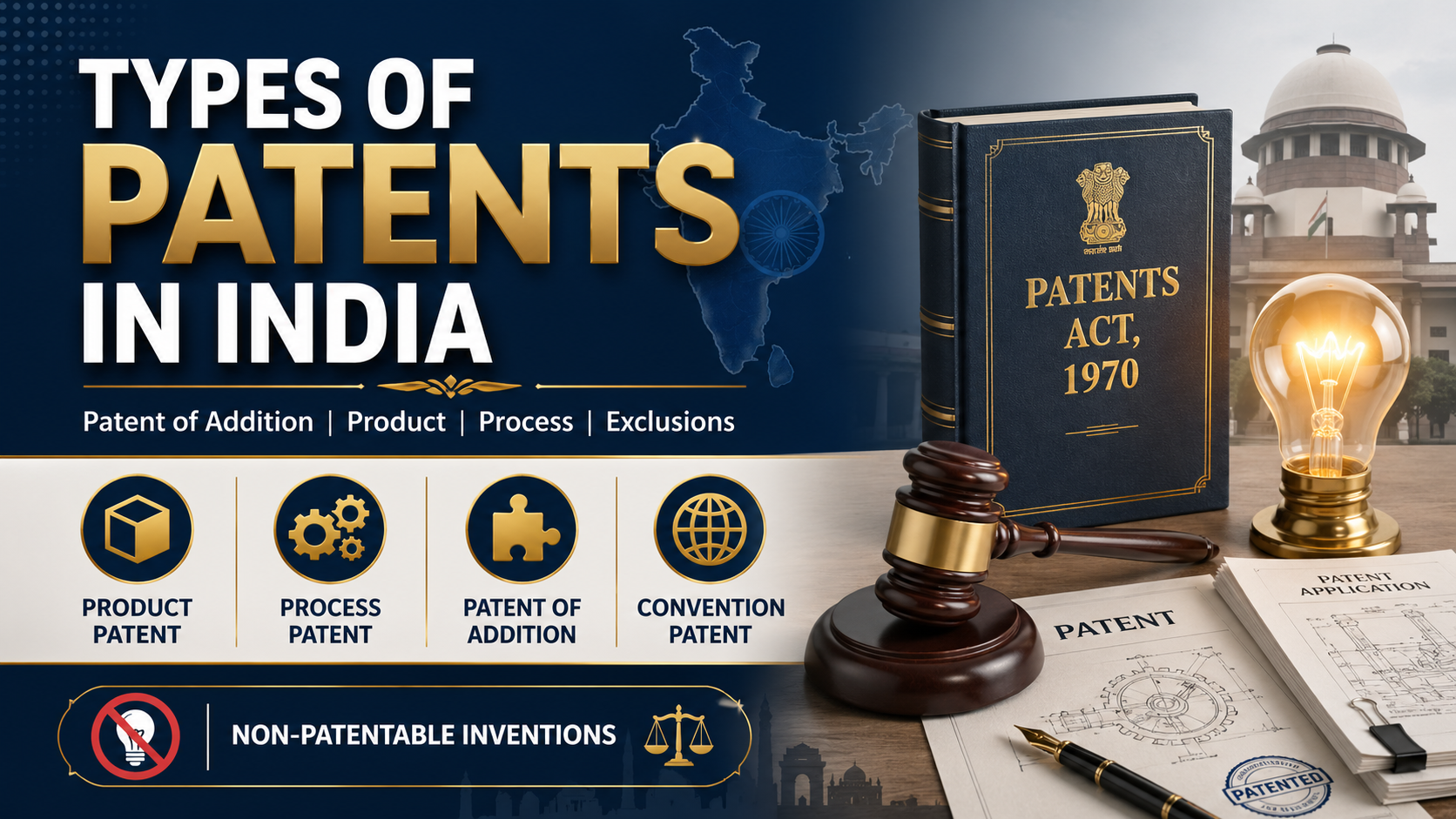
In India, the main types of patents are:
- Product Patents
- Process Patents
- Patents of Addition
- Convention Patents
- (Other practical categories like Divisional Applications are also sometimes included.)
These categories ensure that both end-products and methods of producing them, as well as improvements and international filings, are protected within the patent system.
1. Product Patents
A product patent protects a new article, composition, or substance itself. This means that if someone is granted a product patent, he has the exclusive right over the product, no matter which method is used to make it.
Legal Basis:
- Section 2(1)(j): “Invention” includes both products and processes.
- Before the 2005 Amendment, India did not allow product patents in medicines, chemicals, and food (old Section 5). Only process patents were recognized. This was done to keep essential goods affordable.
- After India joined the WTO–TRIPS regime, the 2005 Amendment allowed product patents in all fields of technology.
Example:
If an inventor discovers a new anti-cancer drug molecule, a product patent prevents others from making or selling that drug, even if they use a different manufacturing process.
Case Law:
- Novartis AG v. Union of India (2013): Novartis sought a product patent for “Glivec.” The Supreme Court rejected it under Section 3(d), holding that it was only a new form of an existing substance without increased efficacy. This case shows how product patents are subject to strict scrutiny in India, especially in medicines.
2. Process Patents
A process patent protects the method of making a product. The invention lies in the process rather than the product itself.
Legal Basis:
- Section 2(1)(j) covers both products and processes.
- Under old Section 5 (before 2005), medicines, food, and chemicals were only eligible for process patents. This allowed Indian companies to manufacture generic versions of patented drugs by using alternative processes, which made drugs affordable.
Example:
If an inventor develops a cheaper and more efficient method of manufacturing penicillin, he may get a process patent. However, other manufacturers may still produce penicillin if they use a different process.
Case Law:
- Biswanath Prasad Radhey Shyam v. Hindustan Metal Industries (1979): The Court observed that a mere workshop improvement does not qualify as a process patent. The process must involve an inventive step and produce a new result.
3. Patents of Addition
Innovation is a continuous journey. After inventing something, inventors often develop improvements or modifications. To accommodate this, the Act provides for patents of addition.
Legal Basis:
- Sections 54–56, Patents Act, 1970.
- Section 54: Patents of addition can be granted for modifications or improvements of an existing patent (called the main patent).
- Section 55: The patent of addition expires with the main patent and does not have its own 20-year term. No separate renewal fee is required.
- Section 56: It cannot be revoked merely on the ground that it does not involve an inventive step.
Example:
If an inventor patents a solar panel in 2020 and later discovers a new heat-resistant coating for it, he can file for a patent of addition rather than a new patent.
Case Law:
- F. Hoffmann-La Roche Ltd. v. Cipla Ltd. (2009): The Delhi High Court noted that patents of addition are particularly relevant in pharmaceuticals, where incremental improvements are important.
4. Convention Patents
In today’s world, inventors often seek patent protection in multiple countries. To facilitate this, the Indian Act allows for convention applications that claim priority from a foreign application.
Legal Basis:
- Section 135, Patents Act, 1970.
- If an application is first filed in a convention country (one that is a signatory to the Paris Convention or WTO), a corresponding application can be filed in India within 12 months, claiming the priority date of the first application.
Example:
If an inventor files an application in the USA in January 2024, and then files in India in July 2024 (within 12 months), the Indian application will be treated as if it was filed in January.
This system helps inventors protect their inventions internationally without losing priority.
5. Other Categories (Practical Types)
Though the main legal categories are above, two other practical types exist:
- Divisional Patents (Section 16): If one application claims more than one invention, it can be divided into separate applications.
- Patent of Importation (Repealed): Earlier, inventions patented abroad and then imported into India could be protected, but this is no longer available after TRIPS compliance.
Importance of Recognizing Different Types
- Protects both final products and methods of creation.
- Encourages incremental improvements through patents of addition.
- Helps Indian inventors secure international rights through convention patents.
- Creates a balanced system that promotes innovation while respecting global obligations (TRIPS).
Conclusion
The Indian patent system is structured to cover different needs of inventors. Product patents safeguard the invention itself, process patents secure the method of making it, patents of addition protect improvements, and convention patents safeguard international rights. This variety ensures that the patent system remains flexible, fair, and consistent with global standards while also addressing national interests such as affordable access to medicines.
FAQ
Q1. What is a Patent of Addition under the Patents Act, 1970?
Answer: A patent of addition is granted under Section 54 for improvements or modifications in an invention for which a main patent has already been granted. It is dependent on the main patent and cannot be granted earlier than it.
Q2. Explain the term and fee structure of a Patent of Addition.
Answer: Under Section 55, the patent of addition expires with the main patent and does not get a separate 20-year term. No separate renewal fee is payable for it, as the renewal of the main patent also covers the patent of addition.
Q3. Can a Patent of Addition be revoked for lack of inventive step?
Answer: No. As per Section 56, a patent of addition cannot be invalidated on the ground that the improvement does not involve an inventive step, as long as it relates to the main invention.
Q4. List and explain five categories of non-patentable inventions under Section 3 of the Patents Act, 1970.
Answer: Five such categories are: (1) Frivolous inventions, (2) Inventions contrary to morality, (3) Discovery of scientific principles, (4) Mere discovery of new form of known substance without enhanced efficacy (Sec. 3(d)), and (5) Methods of agriculture. These are excluded to prevent misuse of patent rights and protect public interest.
Q5. Why did the Supreme Court reject Novartis’s patent application in the Glivec case?
Answer: In Novartis AG v. Union of India (2013), the Court held that the claimed drug was only a new form of an existing substance without enhanced therapeutic efficacy. Hence, under Section 3(d), it was not patentable.
Q6. What does Section 4 of the Patents Act provide?
Answer: Section 4 prohibits patents for inventions relating to atomic energy. Such matters are regulated under the Atomic Energy Act, 1962, due to their strategic importance and impact on national security.
Q7. Distinguish between product and process patents in India.
Answer: A product patent protects the invention of the product itself, while a process patent protects only the method of making it. Before 2005, medicines and food were only eligible for process patents under old Section 5, but after TRIPS compliance, India now allows product patents in all fields.
Q8. What is a convention patent? Explain with an example.
Answer: A convention patent under Section 135 allows an inventor to claim priority in India from an application filed earlier in a convention country. The Indian application must be filed within 12 months. For example, if an inventor files in the USA in January and then in India in July, the Indian application enjoys the January priority date.
Q9. Explain the concept of a patent of addition and its advantages.
Answer: Under Sections 54–56, a patent of addition protects improvements or modifications of an already patented invention. It expires with the main patent and requires no separate renewal fee. Its main advantage is convenience and cost-effectiveness for inventors making incremental improvements.


