
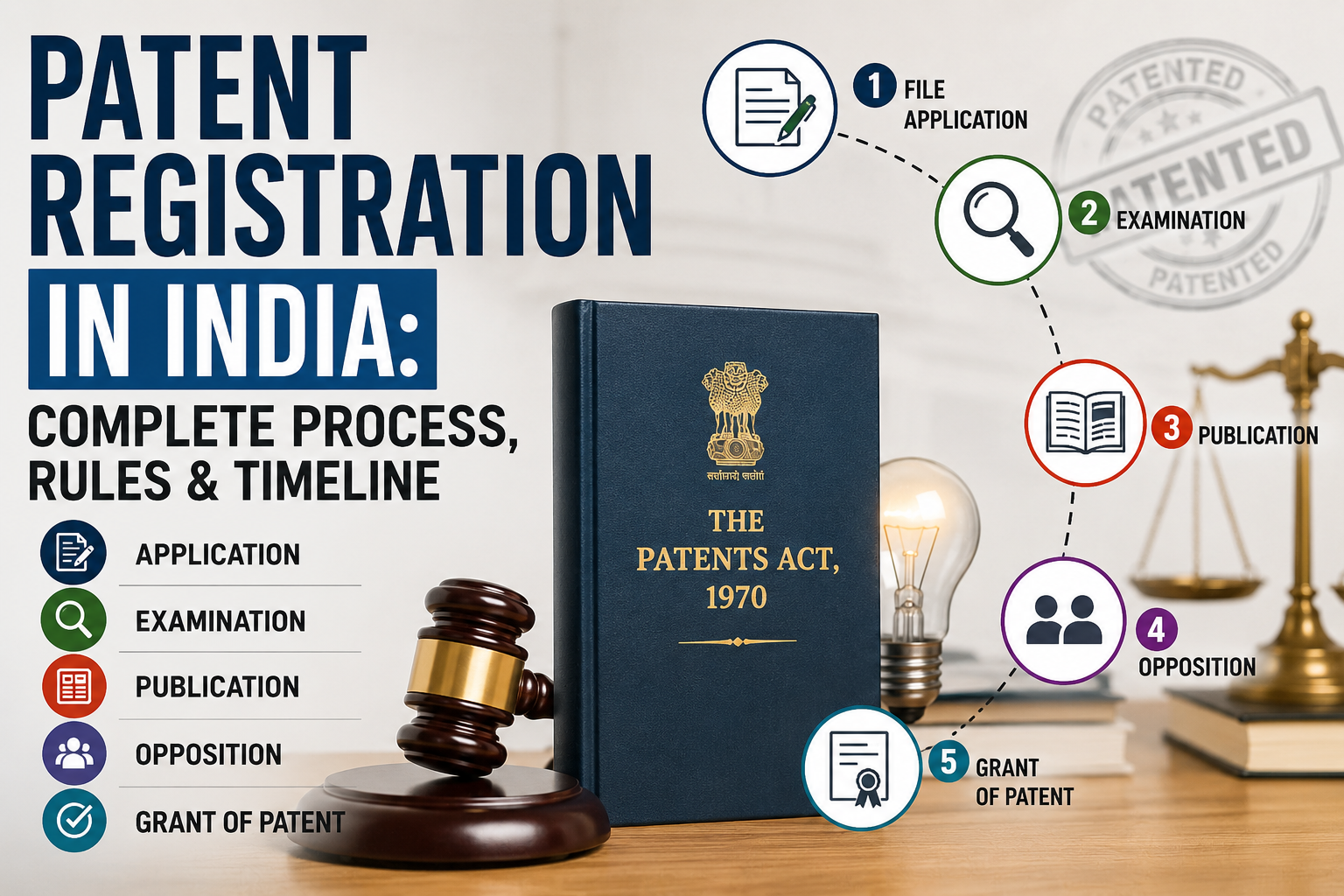
A person does not receive patent protection merely by inventing a new product or process. To obtain exclusive legal rights, the inventor must file a patent application and complete the procedure prescribed under Indian patent law.
The patent registration process in India is primarily governed by the Patents Act, 1970 and the Patent Rules, 2003. These laws explain who can apply for a patent, which documents must be filed, how an application is examined, when objections may be raised, and how the patent is finally granted.
The purpose of this procedure is to ensure that patents are granted only for genuine inventions. Before granting a patent, the Indian Patent Office checks whether the invention:
- is new or novel;
- involves an inventive step;
- is capable of industrial application;
- has been properly disclosed; and
- does not fall under the non-patentable categories listed in Sections 3 and 4 of the Patents Act.
Unlike copyright, which usually arises automatically when an original work is created, patent rights generally become enforceable only after the Patent Office grants the patent.
Who Can Apply for a Patent in India?
Section 6 of the Patents Act, 1970 identifies the persons who are legally entitled to file a patent application.
A patent application may be filed by:
- The true and first inventor
- An assignee of the inventor
- The legal representative of a deceased person who was entitled to apply
The Indian Patent Office also permits two or more eligible persons to file a joint patent application.
True and First Inventor
The true and first inventor is the person who actually developed or conceived the invention.
A person who merely learned about the invention from someone else, financed the research, or followed instructions without making an inventive contribution does not automatically become the inventor.
For example, if two researchers jointly develop a new medical device, both may be named as inventors. However, a person who only provided funding would not normally qualify as an inventor unless that person also contributed to the inventive concept.
Assignee of the Inventor
An inventor may transfer the right to apply for a patent to another person or organisation. The person receiving this right is called the assignee.
An assignee may be:
- an individual;
- a company;
- an employer;
- a university;
- a research institution; or
- another legal entity.
Where the applicant is an assignee, the applicant must provide evidence showing the legal right to apply for the patent.
Legal Representative
If a person entitled to apply for a patent dies before filing the application, the deceased person’s legal representative may file the application.
This prevents the invention from losing protection merely because the inventor died before completing the patent process.
Where Is a Patent Application Filed?
Patent applications in India are administered by the Office of the Controller General of Patents, Designs and Trade Marks, commonly known as the Indian Patent Office.
India has Patent Office branches in:
- Kolkata;
- Delhi;
- Mumbai; and
- Chennai.
The appropriate Patent Office is generally determined by factors such as:
- the applicant’s residence;
- the applicant’s place of business;
- the place where the invention originated; or
- the address for service in India in the case of a foreign applicant.
Most patent applications can now be filed electronically through the official e-filing system of the Indian Patent Office.
Main Types of Patent Applications in India
The correct application route depends on how the invention was developed, whether an earlier application exists, and whether protection is also being sought outside India.
Ordinary Patent Application
An ordinary patent application is filed directly in India without claiming priority from an earlier foreign patent application.
This is commonly used when the inventor first seeks patent protection in India.
Provisional Patent Application
A provisional patent application may be filed when the invention has been conceived but is not yet fully developed.
The main purpose of filing a provisional specification is to secure an early priority date.
The priority date is important because it helps determine whether the invention was new when the patent application was filed. It can also become important where different applicants are working on similar technology.
A provisional specification usually contains:
- the title of the invention;
- the general nature of the invention;
- its main purpose;
- its basic technical features; and
- an initial description of how it works.
A provisional specification does not normally contain the final patent claims.
The applicant must file a complete specification within 12 months from the date of filing the provisional specification. If the complete specification is not filed within that period, the application is treated as abandoned.
A provisional application does not itself result in the grant of a patent. It gives the applicant additional time to develop the invention while preserving an earlier filing date.
Complete Patent Application
A complete patent application contains the final and detailed disclosure of the invention.
Section 10 of the Patents Act requires the complete specification to describe the invention fully and clearly. The description should enable a person skilled in the relevant technical field to understand and perform the invention.
A complete specification ordinarily contains:
- the title of the invention;
- the field of technology;
- the background of the invention;
- the problem addressed by the invention;
- the objectives of the invention;
- a detailed description;
- the best method of performing the invention;
- drawings or diagrams, where necessary;
- an abstract; and
- patent claims.
The claims are the most legally important part of the complete specification. They define the exact boundaries of the protection sought by the applicant.
If a feature is described in the specification but is not properly included in the claims, the applicant may not receive exclusive protection over that feature.
Convention Application
A convention application is filed in India by claiming priority from an earlier patent application filed in a convention country.
The Indian application must ordinarily be filed within 12 months from the filing date of the first application.
For example, if an applicant first files a patent application in Japan and then files a convention application in India within 12 months, the applicant may claim the filing date of the Japanese application as the priority date in India.
PCT National Phase Application
An applicant who has filed an international application under the Patent Cooperation Treaty, commonly known as the PCT, may enter the Indian national phase.
The PCT system provides a common international filing route. However, it does not grant a single worldwide patent.
The applicant must enter the national phase in each country where patent protection is required. Once the application enters India, it is examined according to the Patents Act and Patent Rules.
Divisional Application
A divisional application may be filed where an earlier patent application contains claims relating to more than one invention.
Instead of dealing with several distinct inventions in a single application, the applicant may divide the subject matter into separate applications.
Each divisional application must be based on material already disclosed in the original application. New subject matter cannot be introduced merely by filing a divisional application.
Patent of Addition
A patent of addition may be obtained for an improvement or modification of an invention covered by a main patent or main patent application.
It is useful where an inventor improves an existing invention after filing the original patent application.
Patents of addition are governed by Sections 54 to 56 of the Patents Act.
Step 1: Identifying the Patentable Invention
Before filing an application, the inventor should clearly identify what has actually been invented.
A patent cannot be granted for a vague idea. The applicant must be able to explain:
- what the invention is;
- how it works;
- what technical problem it solves;
- how it differs from existing knowledge; and
- why it is not obvious to a skilled person.
The applicant should also determine whether the invention is a product, a process, or a combination of both.
For example, a newly developed water-purification machine may involve:
- a new physical product;
- a new filtration process; or
- both the machine and the method used by it.
Clearly identifying the inventive concept makes patent drafting and examination more effective.
Step 2: Conducting a Prior-Art Search
A prior-art search is an important step before filing a patent application.
Prior art includes information that was publicly available before the relevant priority date. It may include:
- earlier patents;
- published patent applications;
- research papers;
- scientific journals;
- books;
- technical manuals;
- conference presentations;
- existing products;
- public demonstrations; and
- online publications.
The purpose of the search is to determine whether the invention is already known.
A prior-art search helps the applicant assess:
- whether the invention is new;
- whether it involves an inventive step;
- whether similar technology already exists;
- how the invention differs from earlier inventions; and
- how the claims should be drafted.
A patent search does not guarantee that a patent will be granted. However, it can prevent the applicant from spending time and money on an invention that is already part of public knowledge.
Step 3: Drafting the Patent Specification
The patent specification is the central document in the application process.
It performs two important functions:
- It explains the invention to the public.
- It defines the legal protection sought by the applicant.
The specification must be sufficiently clear and complete. A skilled person should be able to perform the invention by following the disclosure without requiring excessive further experimentation.
The applicant must also disclose the best method known for carrying out the invention.
Poor drafting may lead to:
- objections from the examiner;
- unclear or narrow protection;
- refusal of the application;
- difficulty in proving infringement; or
- revocation of the patent after grant.
The specification should therefore avoid unnecessary technical confusion, unsupported statements, and claims that are broader than the actual invention.
Step 4: Filing the Patent Application
The application must be filed using the prescribed forms and must be accompanied by the necessary documents and official fees.
Depending on the nature of the application, the required documents may include:
- the application for grant of patent;
- provisional or complete specification;
- drawings;
- abstract;
- statement and undertaking regarding foreign applications;
- declaration of inventorship;
- proof of the applicant’s right to apply;
- authorisation of a registered patent agent;
- priority documents; and
- documents establishing start-up, small-entity, or educational-institution status.
After filing, the Patent Office provides an application number and records the filing date.
The filing date is extremely important because it may determine the applicant’s priority against later applications for similar inventions.
Step 5: Publication of the Patent Application
Under Section 11A, a patent application is ordinarily published after the expiry of 18 months from the filing date or priority date, whichever is earlier.
Publication makes information about the application available to the public.
After publication, members of the public may ordinarily inspect:
- the title of the invention;
- the name of the applicant;
- the names of the inventors;
- the abstract;
- the specification;
- the claims; and
- other publicly available documents.
An application may not be published where:
- a secrecy direction is in force;
- the application has been abandoned; or
- the application was withdrawn within the prescribed period before publication.
Early Publication of a Patent Application
An applicant does not always have to wait for the normal 18-month publication period.
Under Rule 24A, the applicant may request early publication by filing the prescribed request.
Early publication may be useful where the applicant wants to:
- move towards examination more quickly;
- inform investors about the pending application;
- begin licensing discussions;
- publicly establish the existence of the application; or
- receive the limited benefits that arise after publication.
Early publication and expedited examination are separate procedures. Early publication only makes the application publicly available. It does not automatically place the application in an expedited examination queue. Rules 24A, 24B and 24C separately deal with early publication, ordinary examination and expedited examination.
Rights Available After Publication
Publication gives the applicant certain limited rights.
Under the Patents Act, the applicant receives privileges similar to those of a patentee from the date of publication. However, the applicant cannot normally begin infringement proceedings until the patent has actually been granted.
If the patent is later granted, the patentee may seek relief for qualifying acts committed after the publication date, subject to the claims as finally granted.
Publication should therefore not be confused with registration.
A published patent application may still be:
- opposed;
- amended;
- refused;
- withdrawn;
- abandoned; or
- granted with narrower claims.
Step 6: Filing the Request for Examination
The Patent Office does not automatically examine every application immediately after filing or publication.
A separate Request for Examination, commonly called an RFE, must be filed.
Under the Patent Rules as amended in 2024, the general time limit for filing the examination request is 31 months from the filing date or priority date, whichever is earlier, for applications governed by the amended rule.
Applications filed before the Patent (Amendment) Rules, 2024 came into force continue to receive the benefit of the earlier applicable examination period. The 2024 amendment replaced the earlier 48-month period with 31 months while preserving the earlier period for applications filed before the amendment.
If the request for examination is not filed within the applicable period, the application is treated as withdrawn.
The request may be filed by:
- the applicant; or
- another interested person.
However, official examination communications are ordinarily sent to the applicant or the authorised patent agent.
Step 7: Examination by the Indian Patent Office
Once a valid examination request is filed, the Controller refers the application to a patent examiner.
The examiner studies the application and searches existing technical information to determine whether the legal requirements have been satisfied.
The examination generally covers:
- novelty;
- inventive step;
- industrial applicability;
- patentable subject matter;
- clarity of claims;
- support for the claims in the description;
- sufficiency of disclosure;
- unity of invention;
- earlier patent applications;
- prior publication;
- compliance with filing requirements; and
- exclusions under Sections 3 and 4.
An invention must be novel, involve an inventive step, be capable of industrial application, and remain outside the exclusions in Sections 3 and 4.
Step 8: First Examination Report
If the examiner identifies objections, the Patent Office issues a First Examination Report, commonly called the FER.
The FER informs the applicant why the application is not yet in order for grant.
Common objections may include:
- the invention is not new;
- the invention is obvious;
- the claims are unclear;
- the claims are not supported by the description;
- the specification does not fully disclose the invention;
- the application contains more than one invention;
- the invention falls under Section 3 or Section 4;
- required documents have not been submitted; or
- foreign filing information is incomplete.
Receiving an FER does not mean that the patent has been finally refused. It gives the applicant an opportunity to answer the objections and amend the application where permitted.
Responding to the First Examination Report
The applicant may respond by:
- submitting legal arguments;
- providing technical explanations;
- distinguishing the invention from prior art;
- amending the claims;
- correcting formal defects;
- submitting supporting documents; or
- requesting a hearing.
The application must ordinarily be placed in order for grant within six months from the date of issuance of the FER. Rule 24B permits an extension of up to three months on a timely request, and the current Rules also contain a broader extension or condonation mechanism under Rule 138 in qualifying circumstances.
The applicant must respond carefully to every objection. Ignoring even one material objection may prevent the application from proceeding to grant.
Step 9: Hearing Before the Controller
If objections remain after the applicant files the FER response, the Controller may provide an opportunity for a hearing.
At the hearing, the applicant or patent agent may explain:
- why the invention is new;
- why it involves an inventive step;
- why it is industrially applicable;
- why it is not excluded under Sections 3 or 4;
- how the claims are supported by the specification; and
- why the application should be allowed.
After considering the written response and oral submissions, the Controller may:
- accept the application;
- require further amendments;
- allow some claims and refuse others; or
- refuse the application.
A hearing is therefore an important opportunity to address unresolved legal and technical objections before a final decision is made.
Step 10: Pre-Grant Opposition
Section 25(1) allows any person to challenge a patent application after its publication but before the grant of the patent.
This is known as a pre-grant opposition.
A pre-grant opposition may be based on grounds such as:
- wrongful obtaining of the invention;
- earlier publication;
- earlier claiming;
- prior public knowledge or use;
- lack of novelty;
- lack of inventive step;
- non-patentable subject matter;
- insufficient disclosure;
- failure to provide required foreign-application information;
- incorrect convention priority; or
- use of traditional knowledge.
The purpose of pre-grant opposition is to prevent the grant of weak, invalid, or undeserving patents.
The Controller considers the opponent’s representation, the applicant’s reply, the evidence produced by both sides, and the legal requirements before making a decision.
Step 11: Grant of the Patent
A patent is granted under Section 43 when the application is found to be in order and is not refused or found to violate the Patents Act.
After grant:
- the patent number is issued;
- the date of grant is entered in the Register of Patents;
- the fact of grant is published in the Patent Office Journal; and
- the application, specification, and related documents become available for public inspection.
The grant converts the applicant’s pending claim into enforceable patent rights, subject to the conditions, exceptions, and limitations contained in the Act.
Step 12: Post-Grant Opposition
Even after a patent has been granted, it may be challenged through a post-grant opposition.
Under Section 25(2), a post-grant opposition may be filed by a person interested within one year from the publication of the grant.
A person interested may include someone having a genuine commercial, technical, research, or legal interest in the patented technology.
Unlike a pre-grant opposition, which may be filed by any person, a post-grant opposition requires the opponent to show an actual interest in the subject matter.
After considering the Opposition Board’s recommendation and hearing the parties, the Controller may:
- maintain the patent;
- require amendment of the patent; or
- revoke the patent.
Term of a Patent in India
Under Section 53 of the Patents Act, the normal term of a patent is 20 years from the filing date of the application.
For a PCT national phase application, the term is generally calculated from the international filing date.
The patent term is not calculated from the date on which the patent was granted. Therefore, time spent during examination ordinarily forms part of the 20-year period.
The patentee must pay the prescribed renewal fees to keep the patent in force. Failure to pay the required fees may cause the patent to lapse, subject to the restoration provisions of the Act.
Expedited Examination of Patent Applications
Rule 24C provides an expedited examination route for eligible applicants.
Expedited examination allows an eligible application to be taken up for examination more quickly than an ordinary application.
Depending on the conditions stated in the current Patent Rules, eligible applicants may include:
- start-ups;
- small entities;
- female natural-person applicants;
- government departments;
- institutions established by law;
- government-owned or controlled institutions;
- government companies;
- applicants covered by an arrangement between the Indian Patent Office and a foreign patent office; and
- applicants who selected India as the International Searching Authority or International Preliminary Examining Authority in qualifying cases.
Expedited examination does not guarantee the grant of a patent. It only provides faster examination.
The invention must still satisfy all requirements relating to:
- novelty;
- inventive step;
- industrial application;
- disclosure;
- claim drafting; and
- patentable subject matter.
Difference Between Early Publication and Expedited Examination
Early publication and expedited examination are often confused, but they serve different purposes.
| Basis | Early Publication | Expedited Examination |
|---|---|---|
| Relevant rule | Rule 24A | Rule 24C |
| Main purpose | Makes the application public earlier | Places the application in a faster examination track |
| Eligibility | Generally available on request, subject to legal restrictions | Available only to eligible applicants |
| Effect | Publication takes place before the ordinary 18-month period | Examination is conducted on priority |
| Guarantees grant | No | No |
An applicant seeking faster processing may need to request early publication as well as expedited examination, depending on the status of the application.
Effect of Patent Registration
Once a patent is granted, Section 48 gives the patentee the exclusive right to prevent unauthorised commercial use of the invention.
For a product patent, the patentee may prevent third parties from:
- making the patented product;
- using the product;
- offering it for sale;
- selling it; or
- importing it for those purposes.
For a process patent, the patentee may prevent third parties from:
- using the patented process; and
- using, offering for sale, selling, or importing a product directly obtained through that process.
These are primarily rights to stop others from using the invention without permission. They do not always amount to an unrestricted right to commercially use the invention.
Other patent rights, earlier patents, government approvals, statutory exceptions, public-interest provisions, and regulatory laws may still affect how the invention can be used. Section 48 defines the principal product and process patent rights granted to the patentee.
The grant of a patent also creates continuing responsibilities. The patentee must maintain the patent, pay renewal fees, comply with legal disclosure requirements, and exercise the patent rights within the limits imposed by Indian law.
Conclusion
Patent registration in India follows a detailed legal process designed to protect genuine inventions while preventing unjustified monopolies. An applicant must identify the invention clearly, prepare a proper specification, file the required documents, request examination within the applicable period, and respond carefully to objections raised by the Patent Office.
Publication, examination, opposition, and hearings help ensure that a patent is granted only when the invention is new, involves an inventive step, is capable of industrial application, and does not fall within the exclusions under the Patents Act, 1970.
Once granted, a patent generally remains valid for 20 years from the filing date, subject to payment of renewal fees and compliance with the law. The patentee receives exclusive rights over the patented product or process, but these rights remain subject to public-interest safeguards, statutory exceptions, and continuing legal obligations.
A well-drafted specification, timely filing, a proper prior-art search, and an accurate response to the First Examination Report can significantly improve the chances of obtaining meaningful patent protection in India.