
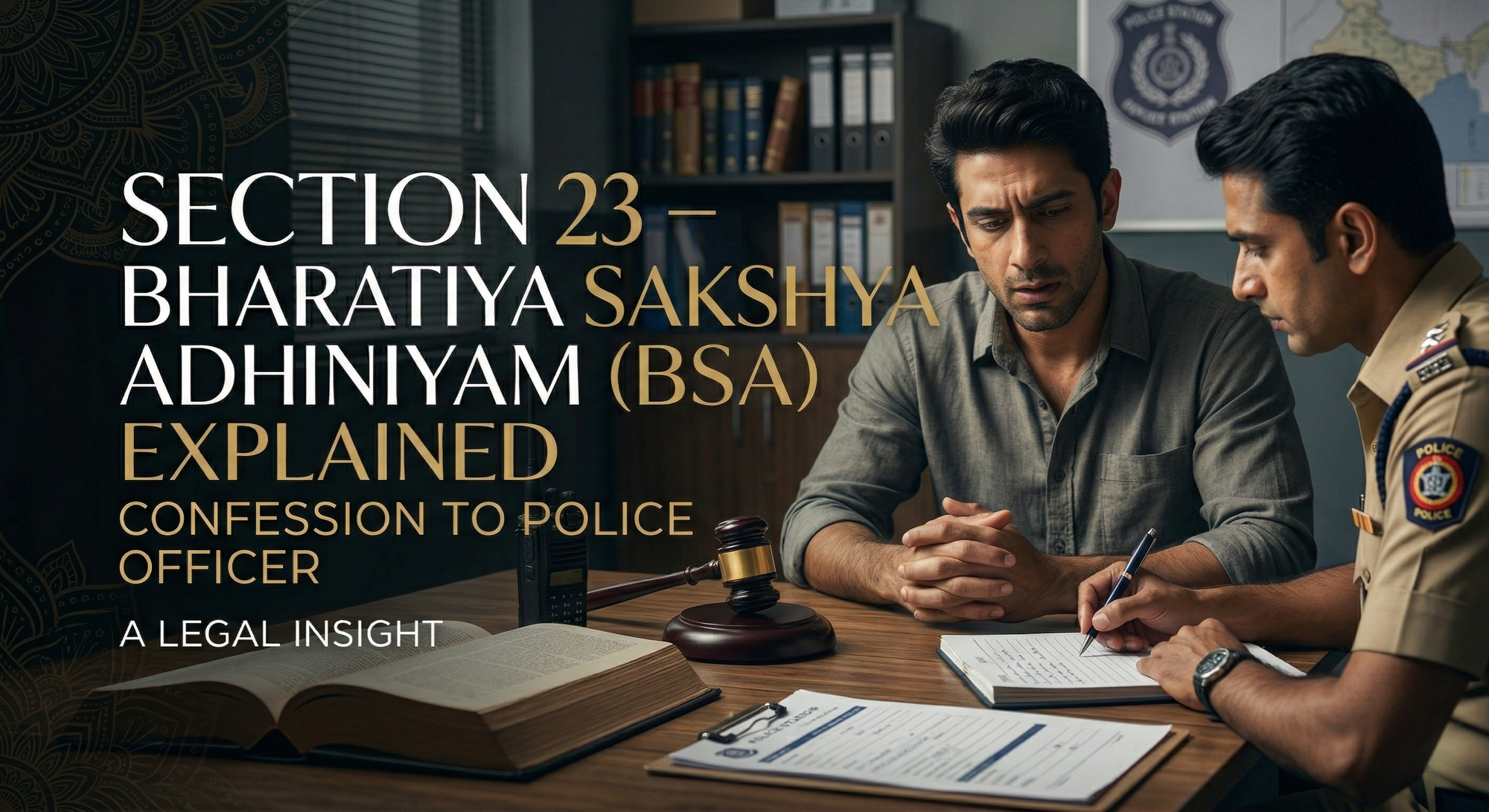
1. Statutory Provision (BSA, 2023)
Section 23 of the BSA states:
(1) No confession made to a police officer shall be proved as against a person accused of any offence.
(2) No confession made by any person while he is in the custody of a police officer shall be proved against him unless it is made in the immediate presence of a magistrate.
Proviso: If information received from a person in custody leads to the discovery of a fact, then the portion of that information relating distinctly to the discovered fact can be proved.
This rule reflects a strong safeguard — confessions to police officers are inadmissible in court unless made in front of a magistrate or leading to the discovery of a fact.
2. Rationale Behind Section 23
This section is grounded in public policy. The law presumes that police officers may sometimes use coercion, pressure, or manipulation to get confessions. So, even if a confession is true or voluntary, it can't be used as evidence against the accused.
The courts have emphasised that this exclusion is absolute it does not matter:
- Whether the police officer used force or not
- Whether the statement was voluntarily made
- Whether the statement is true
If a confession is made to a police officer, it cannot be used against the person in a criminal trial.
3. Who is Considered a Police Officer?
The courts have interpreted "police officer" broadly. It includes:
- Regular police personnel
- Officers given police-like investigative powers (e.g., excise officers, railway police, anti-corruption officials in some cases)
However, some officials (e.g., customs officers, forest officers) may not fall within this definition unless they have the power to file charge sheets under Section 173 of the CrPC.
The test is whether the officer has substantial powers of investigation and prosecution, including the authority to arrest, investigate, and prosecute.
4. Custodial Confession and the Role of Magistrate
Under sub-section (2), a confession made while a person is in police custody is inadmissible unless it was made in the immediate presence of a Magistrate. This is an extension of the safeguard even if the confession is not made directly to a police officer, if the person is in custody and not in front of a Magistrate, it cannot be used.
This ensures that confessions are monitored and recorded by a neutral authority who can confirm whether the confession was free and voluntary.
5. Exception – Discovery of Facts (Section 27 Principle)
The only exception allowed under Section 23 is where the confession leads to the discovery of a material fact. If a person in custody tells the police something like “I buried the murder weapon under the mango tree,” and the police recover the weapon from that place, the part of the confession that directly leads to the discovery can be admitted in court.
But only that specific portion which relates to the discovery is admissible. The rest of the confession, such as motive or how the crime was committed, remains inadmissible.
6. Important Judicial Interpretation
In Sita Ram v. State of U.P. (AIR 1966 SC 1906), the accused left a confession letter addressed to the police near the victim’s body. The court ruled that this was not a confession to a police officer, as the officer was unaware of it at the time. Therefore, it was not excluded under the rule.
But this judgment is applied narrowly. Any confession made under the direction or knowledge of a police officer is considered as made to him, even if communicated indirectly (e.g., through another person, over phone, or in a letter).
7. Summary of Legal Position
|
Rule |
Details |
|
General Rule |
Confession to a police officer is inadmissible. |
|
Custodial Confession |
Not admissible unless made before a Magistrate. |
|
Exception |
Discovery of a fact directly from the confession is admissible. |
|
Who is a Police Officer? |
Anyone with powers of investigation and charge-sheeting. |
|
Test |
Was the statement made to or in custody of police? Was it voluntary
and before a Magistrate? |
8. Conclusion
Section 23 of the BSA (2023) creates powerful protection for accused persons, ensuring that no confession made to a police officer—however truthful or voluntary can be used against them unless it is legally supervised. This provision upholds the principle that justice must be based on reliable, free, and voluntary evidence and not influenced by fear or pressure. It also emphasises the role of the magistrate as a neutral authority to oversee confessions, and the narrow exception for discovery ensures that useful evidence is not lost, while also respecting the rights of the accused.
FAQ
1) Is a confession made to a police officer admissible in court under Section 23 BSA?
No. Section 23(1) clearly says a confession made to a police officer cannot be proved against the accused.
Even if it is voluntary or true, it remains inadmissible.
2) Is a confession made in police custody admissible under Section 23(2) BSA?
Generally, no. A confession made while a person is in police custody is inadmissible.
It becomes admissible only if made in the immediate presence of a Magistrate.
3) What is the exception to Section 23 BSA for “discovery of fact”?
If information given by an accused in custody leads to the discovery of a new fact, the portion related to that discovery can be proved.
Only the part that “distinctly relates” to what was discovered is admissible.
4) What does “immediate presence of a Magistrate” mean in Section 23?
It means the confession must be made directly before the Magistrate, with the Magistrate present and supervising.
This safeguard helps ensure the statement is free, voluntary, and not forced.
5) Who is considered a “police officer” for Section 23 BSA purposes?
It usually includes officers who have police-like powers of investigation, such as arrest, investigation, and prosecution.
Courts often apply a functional test based on the nature of powers, not just the job title.
6) Can a confession made in a letter or phone call to the police be used as evidence?
If it is treated as a confession “to a police officer,” it is generally inadmissible under Section 23.
However, facts can change the outcome—for example, if it was not communicated as a confession to the police in the legal sense.
7) What is the main purpose of Section 23 BSA 2023?
It protects accused persons from convictions based on confessions obtained through pressure, coercion, or misuse of custody.
The law prefers reliable evidence and insists on Magistrate oversight for custodial confessions.