
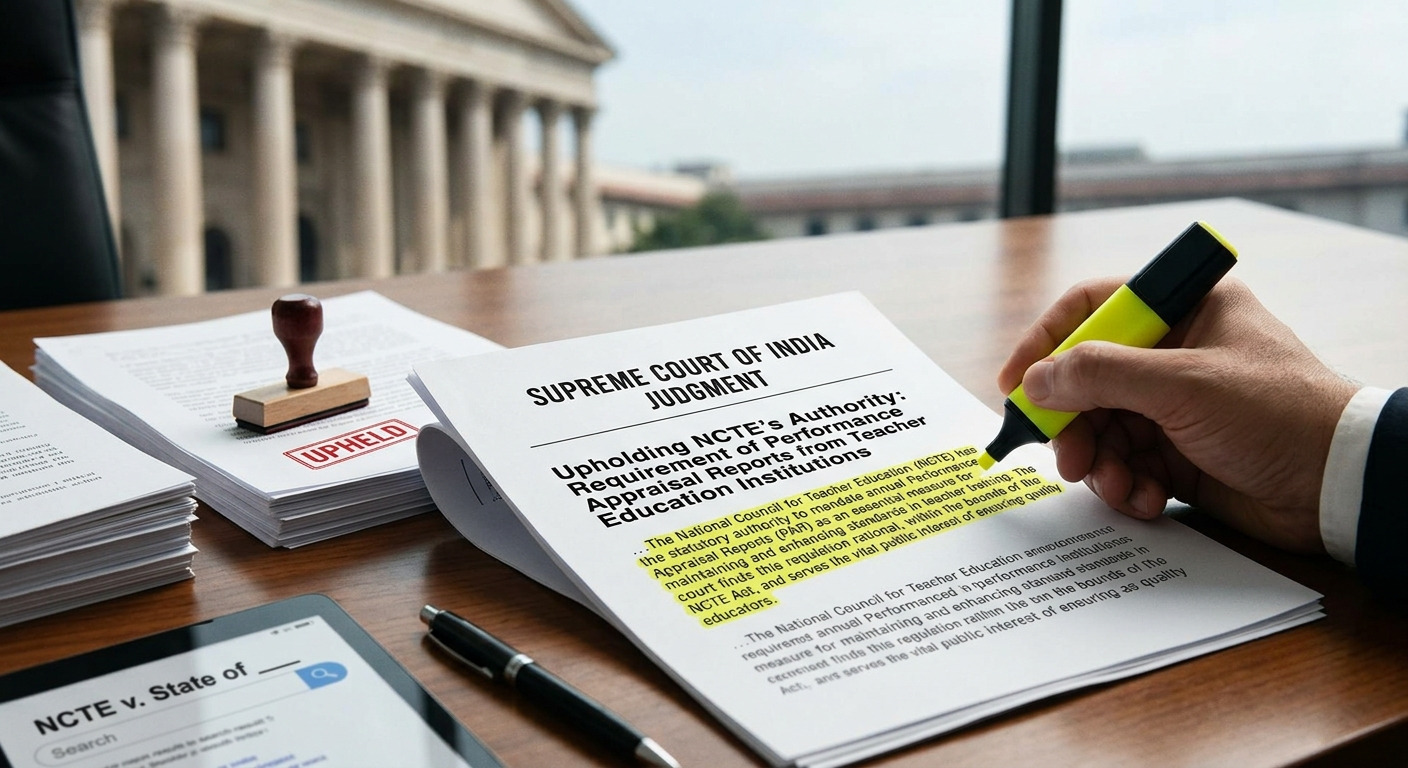
The Supreme Court has upheld the authority of the National Council for Teacher Education (NCTE) and its Executive Committee to require recognised teacher-education institutions to submit annual Performance Appraisal Reports (PARs). The Court held that this power flows directly from the National Council for Teacher Education Act, 1993, and is also incidental to the NCTE’s regulatory responsibilities.
The judgment, delivered on 3 September 2026, set aside a 2023 decision of the Delhi High Court that had invalidated the NCTE’s 2019 public notice. The Supreme Court clarified that courts reviewing the actions of a statutory regulator must examine those actions in the context of the regulator’s wider legislative mandate.
Key takeaways
- The NCTE can require recognised teacher-education institutions to submit annual Performance Appraisal Reports.
- Section 12(k) of the NCTE Act expressly permits the Council to develop performance-appraisal systems for institutional accountability.
- The NCTE Executive Committee was authorised to implement the Council’s decision through its Member Secretary.
- The processing fee attached to the 2019 public notice was treated as incidental to the regulator’s functions.
- Courts should not invalidate regulatory measures merely on a technical interpretation when the action falls within the purpose and scheme of the statute.
- The judgment validates the NCTE’s authority but does not, by itself, announce a new PAR submission deadline for September 2026.
Case details
Case: The National Council for Teachers Education v. Association of NCTE Approved Colleges Trust and Others
Citation: 2026 INSC 953
Proceeding: Civil Appeal arising from SLP (C) No. 11756 of 2023
Decision date: 3 September 2026
Bench: Justice Pamidighantam Sri Narasimha and Justice Alok Aradhe
Impugned decision: Delhi High Court judgment dated 13 March 2023 in LPA No. 190 of 2021
The proceeding and the Delhi High Court decision from which it arose are also recorded in the Supreme Court’s official office report.
What led to the dispute?
On 22 September 2019, the Member Secretary of the NCTE Executive Committee issued a public notice requiring Teacher Education Institutions, or TEIs, to submit Performance Appraisal Reports for the 2018–19 academic year.
A PAR was intended to provide regulatory information about recognised institutions, including their infrastructure, teaching faculty, financial accounts and compliance with applicable NCTE standards.
The notice prescribed:
- ₹5,000 per institution for Central and State Government institutions;
- ₹15,000 per institution for institutions in other categories;
- an online filing period from 23 September to 31 December 2019; and
- possible action under Section 17(1) of the NCTE Act for non-submission.
Teacher-education institutions challenged the notice. Their principal argument was not that the NCTE could never maintain an accountability system. Instead, they questioned whether the Member Secretary and Executive Committee could introduce and implement the particular PAR requirement without separate approval of the final proforma by the Council.
A Single Judge of the Delhi High Court dismissed the challenge. On appeal, however, a Division Bench held that the record did not establish that the PAR proforma had been placed before and approved by the NCTE itself.
The Division Bench consequently quashed the notice. It did not finally determine whether the required payments amounted to a regulatory fee or an unauthorised tax.
What legal question did the Supreme Court examine?
The central issue was whether the NCTE Council and its Executive Committee had the statutory authority to require recognised institutions to file annual PARs.
This involved three connected questions:
- Whether the power could be traced to the NCTE Act;
- whether the Executive Committee could implement the Council’s decision; and
- whether the processing payment prescribed by the notice was legally supportable.
The Supreme Court examined these questions within the complete statutory framework rather than treating the Member Secretary’s notice as an isolated administrative action.
How does the NCTE Act distribute regulatory powers?
The NCTE is a statutory regulator established under Section 3 of the National Council for Teacher Education Act, 1993. Its primary responsibility under Section 12 is to secure the planned and coordinated development of teacher education and the determination and maintenance of standards.
Section 12 gives the Council several specific functions. These include conducting surveys, coordinating teacher education, framing guidelines, reviewing the implementation of standards and regulating recognised institutions.
Most importantly for this case, Section 12(k) authorises the Council to evolve a suitable performance-appraisal system, including norms and mechanisms for enforcing accountability upon recognised institutions.
The Act also creates an Executive Committee under Section 19. This committee performs functions assigned by the Council or determined through regulations. Regional Committees constituted under Section 20 deal with matters including institutional recognition.
The Supreme Court therefore found that the Council possesses the substantive regulatory power, while the Executive Committee operates as its implementing body.
Why did the Supreme Court uphold the PAR requirement?
Section 12(k) expressly supports performance appraisal
The Court held that the authority to require PARs could be directly traced to Section 12(k). That provision is specifically concerned with creating performance-appraisal systems and enforcing accountability among recognised institutions.
The Council had considered the issue during its 48th General Body meeting on 5 February 2019. Earlier, it had contemplated a system of annual renewal of recognition. After litigation showed that annual renewal would not be feasible, the Council decided to substitute it with a PAR-based system.
The recorded decision authorised the NCTE to proceed through a proforma developed for that purpose. The Court concluded that the Council had considered the matter and approved the implementation of a performance-appraisal mechanism. Paragraphs 18–21 of the judgment discuss the meeting and the statutory source of power.
The Executive Committee could implement the Council’s decision
The Supreme Court described the Executive Committee as the body that actually discharges the functions assigned to it by the Council.
Once the Council decided to proceed with the PAR system, the Executive Committee was entitled to implement that decision. The Member Secretary’s public notice was therefore an implementation of an existing Council decision, rather than an independent attempt to create a new regulatory regime.
This finding answered the concern that the Member Secretary had acted without the Council’s authority.
Regulators also possess incidental and ancillary powers
The Court went beyond Section 12(k) and explained a broader principle of administrative law. Even when a statute does not spell out every procedural step, a regulator may exercise powers that are reasonably incidental or ancillary to its assigned functions.
An incidental power is one that is necessary or reasonably connected to the performance of an express statutory duty. It cannot contradict the statute, but it may enable the regulator to carry out the responsibility Parliament has already given it.
According to the Court, it would be inconsistent to make the NCTE responsible for standards and accountability while denying it the practical ability to collect performance information from the institutions under its supervision.
The Court noted that the NCTE is itself subject to performance audits by the Comptroller and Auditor General of India. Requiring comparable reports from regulated institutions was considered a natural part of its oversight function.
What did the Court say about accountability?
The judgment treats accountability as an important principle of administrative law. It identifies three components:
| Component | Meaning in the judgment |
|---|---|
| Responsibility | Identifying the duties and performance obligations of an institution or authority |
| Answerability | Requiring decisions and conduct to be explained through reasons |
| Enforceability | Permitting corrective action when responsibilities are not fulfilled |
The Court reasoned that judicial review of NCTE action would be meaningful only if the regulator could first obtain reliable information about the institutions it regulates.
It also stated that constitutional courts have two related responsibilities. They must prevent statutory bodies from exercising powers that the law does not confer, but they must also ensure that regulators exercise their lawful powers effectively and accountably.
The judgment cautions against an excessively technical or “pedantic” approach that disables a regulator from fulfilling the purpose of its legislation. This reasoning appears in paragraphs 22–24 of the 17-page judgment.
How did the right to education influence the reasoning?
The Court connected teacher education with Article 21A of the Constitution, which guarantees free and compulsory education to children between six and fourteen years of age.
Section 23 of the Right of Children to Free and Compulsory Education Act, 2009 recognises the importance of minimum teacher qualifications. The NCTE functions as the relevant academic authority for determining those qualifications.
The Court referred to its earlier decision in Dinesh Biwaji Ashtikar v. State of Maharashtra, which identified five duty-bearers responsible for elementary education:
- the appropriate government;
- the local authority;
- the neighbourhood school;
- parents or guardians; and
- the elementary-school teacher.
In the present judgment, the Court added two further duty-bearers: Teacher Education Institutions and the NCTE.
This part of the ruling is significant because it places teacher-training institutions and their regulator within the constitutional framework supporting elementary education. The quality of teacher education was not treated merely as an internal administrative matter.
Was the NCTE permitted to charge a processing fee?
The 2019 public notice required government institutions to pay ₹5,000 and other institutions to pay ₹15,000 while filing the PAR.
The Supreme Court characterised these payments as process fees. It held that the ability to charge such a fee was incidental and ancillary to the NCTE’s regulatory functions.
The Court also recorded that procedural and technical issues concerning the notice were subsequently addressed during the NCTE’s 53rd meeting. Nevertheless, it decided the appeal because clarity regarding the powers of statutory regulators remained necessary.
The ruling should therefore be read in the context of the specific PAR process considered by the Court. It does not mean that a statutory regulator may impose any charge without regard to its parent legislation or other applicable legal requirements.
What was the final decision?
The Supreme Court allowed the NCTE’s appeal and set aside the Delhi High Court’s judgment dated 13 March 2023.
It held that:
- the public notice issued by the Member Secretary was legal and valid;
- the NCTE Council and its Executive Committee had jurisdiction to require TEIs to upload PARs; and
- the payments specified in the notice were supportable as process fees incidental to the regulatory exercise.
No order was made as to costs. The operative conclusion is recorded in paragraphs 25 and 26 of the judgment in 2026 INSC 953.
What are the limits of the ruling?
The judgment does not give regulators unrestricted authority.
A regulatory action may still be challenged when it:
- violates a mandatory provision of the governing statute;
- exceeds the authority conferred by the legislation;
- conflicts with statutory rules or regulations;
- is arbitrary, discriminatory or procedurally unfair; or
- is unrelated to the object for which the regulator was established.
The decision instead confirms that statutory powers must be understood together with the functions they are intended to serve. Where the legislation expressly requires accountability and performance assessment, the regulator may adopt reasonable machinery to implement that mandate.
The judgment also does not create a fresh September 2026 filing window. Institutions should rely on current notices and deadlines published through the official NCTE website and PAR portal, rather than treating the Supreme Court decision itself as a new compliance notice.
Why does this judgment matter beyond teacher education?
The decision provides a useful framework for disputes involving regulatory bodies in education and other specialised fields.
It recognises that legislation often assigns broad responsibilities without listing every administrative tool required for implementation. Courts must therefore examine whether the disputed measure has a real connection with an express statutory duty.
At the same time, incidental powers cannot become an independent source of unlimited jurisdiction. Their validity depends on their relationship with the parent statute.
For lawyers and law students, the judgment is particularly relevant to three areas:
- interpretation of regulatory statutes;
- the scope of incidental and ancillary powers; and
- judicial review of administrative action.
The ruling ultimately restores the PAR notice because performance assessment was not external to the NCTE’s mandate. It was a mechanism for carrying out the accountability function expressly recognised by Section 12(k).
